Hossein Jorjani
First publication: 2026 – 10 – 13
Whether something can properly be called dialectical depends first on what “dialectic” is intended to mean. The historical continuity of the word does not establish continuity of its function or criteria. As discussed in Excursus 087 and Excursus 117, dialectic has served epistemological, soteriological, and ontological purposes. Its usefulness as a method of inquiry or spiritual transformation does not, by itself, establish that reality develops dialectically.
The present discussion concerns dialectic in its ontological, generative role, specifically where claims are made about material reality. Within the Hegel–Marx–Engels tradition, contradiction is assigned a constitutive role in development, together with immanence, determinate negation, and sublation. The stronger claim of a dialectical leap additionally invokes a transformation that is not adequately understood as ordinary continuous change. These commitments must be distinguished from the broader claim that things move, change, or interact.
The criteria become less discriminating when dialectic is extended beyond this conception. The analyses in Three Essays on Dialectic question whether familiar examples of quantity-to-quality transformation demonstrate development generated by internal contradiction. An apparent rupture may instead be explained by thresholds, changes in scale, collective organization, or other identifiable mechanisms. Such examples do not establish dialectical necessity merely because their outcomes appear qualitatively different.
A different broadening occurs when contradiction loses its privileged position. Excursus 067 provisionally places movement at the centre and distinguishes conflictual relations from reciprocal relations. Contradiction, opposition, and struggle then become forms of movement alongside complementarity, cooperation, interdependence, and mutual determination. This broadening accommodates a greater diversity of relations, but it also raises a question: what makes these relations dialectical rather than simply dynamic?
Change and movement alone cannot provide the answer. A rock changes, and processes that appear stationary at one scale may exhibit movement at another. Reciprocity likewise occurs in explanations that make no claim to dialectical ontology. If the designation “dialectical” is to retain discriminatory power, it must identify something beyond the occurrence of movement or interaction.
Another way of defining dialectic, most notably in Gurvitch, but also in different forms in Lukács and Sartre, places totality and the relations between parts and wholes at the centre of analysis. In Gurvitch, this involves totalities that cannot be reduced to their constituents and movements within and among them: between a totality and its constituents, between different totalities, and between constituents belonging to different totalities. These approaches locate their strongest dialectical claims in human and social reality, although their positions on extending dialectic to nature differ.
Irreducible totality supplies a more specific object of analysis than movement alone. Nevertheless, neither irreducibility nor reciprocal determination independently demonstrates that a transformation is generated immanently. When contradiction loses its privileged position, and change or discontinuity cannot independently distinguish dialectical processes, immanence remains a central candidate for preserving the discriminatory power of ontological dialectic.
To assess immanence, however, we must identify a boundary. A cause, condition, or relation can be described as internal or external only relative to something sufficiently specified. If every external influence can be incorporated into an enlarged totality, the assertion that development arises “from within” risks becoming true by definition. The boundary must therefore be justified independently of the wish to describe the process as immanent.
The starting point is the choice of the object of explanation. That object must be specified at the outset and retained throughout the inquiry. If the object is a country’s economy, neither the world economy nor the economy of a single company can silently replace it during the explanatory process. International trade, foreign investment, or the decisions of other countries may be indispensable to explaining the national economy. Their explanatory relevance does not make them internal to the object originally selected.
This requirement does not forbid revising an inquiry. It requires that such a revision be acknowledged as a change in the object of explanation. An expanded object may support a different account, but it cannot retrospectively establish immanence for the original one.
A system may therefore provisionally be understood as a set of entities and their interactions considered together in relation to a specified phenomenon. An explanatory domain describes how those constituents operate and interact, while also examining the assumptions, scope, and applicability of its explanation to other phenomena. These definitions are working formulations. They can be revisited and refined as their relations become clearer.
The distinction between simplicus and compositum, introduced in Excursus 013 and extended in Excursus 090, offers a way of examining explanatory architecture. A simplicus derives its explanatory power from one coherent foundation; a compositum depends on the integration of several principal explanatory contributions. This distinction concerns neither intellectual difficulty nor the complexity of the resulting consequences.
An axiomatic depiction illustrates the distinction. In the ideal simplicus case, one foundational axiom supports a theorem. In the compositum case, several foundations contribute to a common theorem, sometimes through intermediate theorems and sometimes more directly. This is an analogy for explanatory dependence, rather than a claim that all explanations are formal deductions.
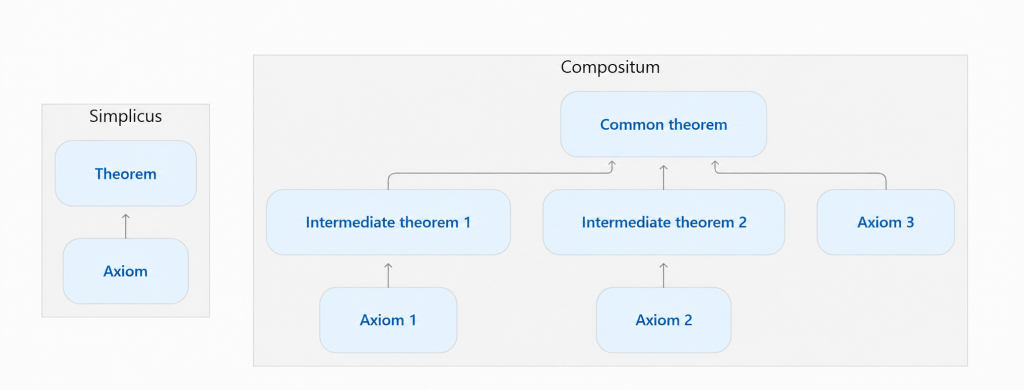
Argumentation supplies a complementary analogy. An explanation may contain one principal argument supported by several auxiliary arguments. Their number does not necessarily make the explanation a compositum: auxiliary arguments may contribute through their support of the principal argument without providing independent explanatory foundations. A compositum instead requires several principal contributions whose combination performs the explanatory work. Their roles and dependencies matter more than a simple count of propositions or mechanisms.
This architecture need not assume a one-cause–one-effect relation. One cause may produce several effects. Conversely, several causes may contribute to one outcome. Uncertainty may concern the strength of these contributions and the relations among them. Causal multiplicity and uncertainty are distinct: several causes may operate deterministically, while even a model with few variables may require probabilistic treatment. Auxiliary evidence and arguments help assess the support for an explanation, sometimes reducing uncertainty and sometimes revealing uncertainty that had previously been overlooked.
For evaluating immanence, it is especially important to distinguish evidential support from causal dependence. Evidence obtained outside the object of explanation does not, merely by its location, establish an external cause. Conversely, an argument described as auxiliary may identify an indispensable external cause. If it does, strict immanence has been refuted. Its subordinate position in the argument does not diminish its causal necessity.
The selected object establishes the scope of inquiry; the causal and inferential structure identifies the dependencies relevant to its explanation. Causal relations concern the processes claimed to produce the outcome. Inferential relations concern how propositions, evidence, and assumptions support the account. Keeping these relations distinct allows us to examine whether an explanation depends on causes within the specified object, causes beyond it, or both.
Neither simplicus nor compositum status settles this question. An explanation with one coherent foundation may depend on indispensable external causes. An explanation integrating several domains may describe contributions that all lie within the specified object. Explanatory unity does not establish immanence, and explanatory plurality does not refute it. The typology helps us inspect dependencies; the location and causal role of those dependencies determine the assessment of immanence.
The criterion adopted here is deliberately strict. A claim that a particular transformation is entirely internally generated fails if an external causal contribution is indispensable to explaining that transformation. The mere presence of internal mechanisms is insufficient. A system may possess the capacity to respond while the occurrence of the response depends on something outside it.
Historical and social examples make the importance of this distinction evident. Was the fall of the Roman Empire, or the dissolution of the Soviet Union, entirely internally generated? Is a central bank’s interest-rate decision explained entirely by domestic economic conditions? These questions do not receive an answer merely by identifying internal tensions or institutional mechanisms. They require examination of the external contributions relevant to the specified outcome. Nor can those contributions be made internal simply by replacing an empire, state, or national economy with a more encompassing totality.
The same requirement applies to examples drawn from nature. The object of explanation must remain fixed while the alleged transformation is investigated using available scientific findings. If an indispensable external cause is identified, the claim of strict immanence fails for that example. If external causation can be excluded, a further question remains: what establishes that the internal process is specifically dialectical, rather than an instance of ordinary internal causation?
This inquiry concerns ontological claims about material reality, including human and social processes. Relations among mentally constructed ideas may be examined dialectically, but their conceptual development cannot independently establish that material reality develops according to the same logic. As emphasized in Excursus 109 and Excursus 145, a representation must be distinguished from what it represents, and necessity within an explanatory system must be distinguished from ontological warrant.
The working hypothesis is that, once objects, boundaries, and causal dependencies are specified consistently, convincing examples of strictly immanent dialectical transformation may prove difficult to identify. This hypothesis requires examination of alleged examples, rather than assertion in advance. If those examples depend on indispensable external causes, or if their internal mechanisms provide no independent warrant for dialectical necessity, they cannot support the proposed ontology.
The issue is therefore not whether reality changes, whether its constituents interact, or whether dialectical inquiry can be intellectually useful. It is whether a specified material transformation provides evidence for the generative role attributed to dialectic. That claim cannot be established by explanatory coherence, by the appearance of rupture, or by enlarging the object until every cause falls within its boundary.
Related excursuses
Excursus 013 – On the Typology of Theoretical Structure: Simplicus vs. Compositum
Excursus 067 – On Conflict and Reciprocity as Forms of Movement
Excursus 087 – On Three Historical Functions of Dialectic
Excursus 090 – On Simplicus and Compositum
Excursus 109 – Reality, Knowledge, and Epistemic Mediation
Excursus 117 – On Dialectic as Method and as Ontology
Excursus 145 — On Philosophical Constructs and Scientific Entities

