Originally written: 2021-05-04
Revised version: 2026-01-31
[The following is a typical conversation that I had with my son (Shams) in my car! In 1998, we moved from Uppsala to a northern suburb of Stockholm (Täby). On many occasions, I gave him a ride from home to Uppsala so he could meet his friends or return home from Uppsala. We had talks about everything, and in this case, apparently, we discussed why I didn’t do any military service. This talk should have occurred around 2001, when he was about to finish high school, and being drafted for military service was a possibility.]
[During our talks, he interrupted my narrative with his questions all the time. I have alluded very briefly to these interruptions in square brackets, i.e., []. My train of thought was often broken by other factors, such as the traffic or, more commonly, by my inner thoughts. I have written these in square brackets as well.]
A few days before we left Scotland (1), a truck from Aer Lingus came to our flat in Great King Street, Edinburgh, to pick up the stuff I wanted to freight to Tehran. Aer Lingus, at that time, was a subcontractor to Iran Air. The deal was that if I could prove in Tehran that I had been a student in the UK, I would pay only a small fee for the freight service.
[Now, how much stuff was it? Well, to be precise, it was 481 KG, of which 360 KG were books and paper reprints.]
A few days after I arrived in Tehran (2), I received a letter from the Iranian Customs Office letting me know I could pick up my stuff at their office at Mehrabad Airport in Tehran.
After the usual round of asking many people about the right office to visit, and finding it, the customs officer told me to pay a huge amount of money as the customs fee and for the freight. “No, no! I was a student! Here, you see! This is my degree from Glasgow University; this is the certificate from Edinburgh University.” I exclaimed! And the customs officer responded very calmly that they only accept an official letter from the Ministry of Higher Education as proof that “I” have been a student! You see, my words or the documents I was carrying had no value. This civil servant was oblivious to all that.
[Is this a good place to talk about the story of my visit to the Swedish Customs Office in 1991? I will tell it anyway. I don’t know where else I can tell it! When Babajoun and Mamanjoun (3) visited Sweden in 1991, they had freighted five Persian carpets to Sweden. Babajoun and I went to the customs office in Arlanda Airport to pick up the carpets. Unfortunately, the customs officer told us we have to pay a fee. The amount would be determined after inspection and appraisal of the carpets. I said the carpets were old, existing in the family homes for many years. Then came the calm response from the customs officer: “Do you have any documents to prove it?”]
[Babajoun and I started to search our minds to see if we could come up with anything. If they still existed, the receipts were in Iran and not easily accessible, while Babajoun and Mamanjoun were in Sweden. We explained this, and I asked the customs officer what other kind of document would be acceptable. He responded that anything, even a picture showing the carpet in the house, would do. I gladly answered that we could find something. So, we sat in the car and drove back home (in Fyrspannsgatan, Hässelby Strand). Searching among the photos, the only thing that we could find was the following picture, a photo that would show one of the carpets under the control of the Swedish Customs Office.]
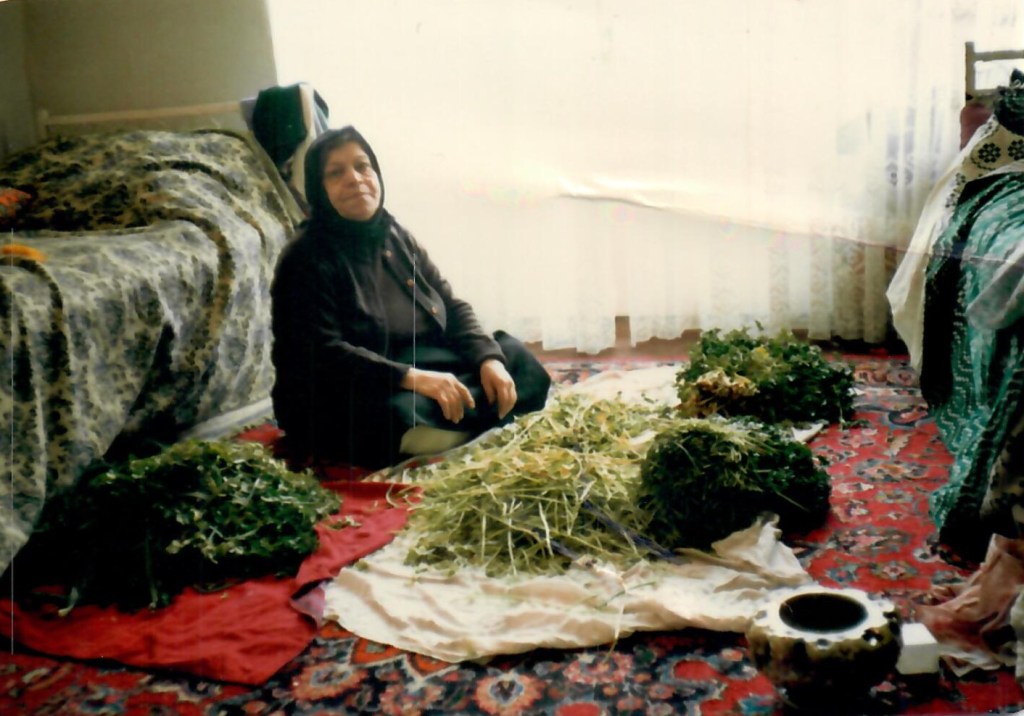
[To be on the safe side, we took with us a few other photos. But we started with the above picture. I told the customs officer that the carpet in the photo was one of the carpets in their storage area. He took the photo from me, looked at it very carefully. Then he moved towards one of his colleagues, who seemed more experienced. I thought nothing of it. He was relatively young and likely needed his boss’s approval. She, the boss, I presumed, seemed competent in her manners. They were whispering, and I could not hear anything.]
[All of a sudden, they moved towards the third colleague and started whispering to her as well. I began to get worried because this third colleague was not older than the first customs officer. She could not have been more experienced. So, why should he and his boss consult with her? It looked suspicious. I thought they were thinking that we might be trying to fool them. As I said, I could not hear them, but they were somehow smiling and giggling. I got a bad feeling. Maybe, they were going to charge us with fraud or something.]
[Then, all three of them came forward to the counter. The “older” lady started talking and told us very slowly that they could accept the photo as evidence. Then, she said, hesitantly, I might add: “What is she doing?”]
[Of course, we got the carpets without paying any fee. And we, Babajoun and I, laughed a lot about the whole incident. And we laughed again when we talked about the incident when we were back at home. And I still laugh about it whenever the story comes to my mind.]
[Ha. Yes. I almost forgot! Vegetables are sold like that in Iran: un-pruned, un-cut, un-washed. So, someone must prepare them before they can be consumed, cooked, or fried. What? That’s beyond the point. The point is that a simple photo resolved a bureaucratic issue in Sweden, but not in Iran.]
Let’s get back to our story. I didn’t have a car. Going from the Customs Office in Mehrabad Airport to the Ministry of Higher Education in downtown Tehran was a big hassle. Arriving at the ministry, they told me that their offices that handled the “translation” of foreign academic degrees were somewhere in Tehran’s northern parts.
[What? Call? where? No! I could not call them. Call them from where? Taking a cab and going there in person would have been more fruitful than calling. At least at that time.]
In any case, I managed to get to the correct part of the town, the right building, the right office, and the right person. I explained that what I needed was really just a certificate from them in order to get my stuff out of customs. The gentleman said they could not issue any certificate before a full evaluation of my academic records had been conducted. He checked my documents and said they were not enough. In addition to what I had, they needed my thesis and the official “diploma”. “Official diploma. Oh dear! I don’t have that yet!” Well. No exception!
It was too late in the day to do anything more. However, I called Edinburgh and asked whether they had mailed the official diploma to me. They said it was on its way and that I would receive it any day. Fortunately, the document arrived a few days later.
This time, I took all the documents that I had and went to the relevant office of the Ministry of Higher Education. I think this must have been late November or early December. I presented all the documents. The respected civil servant told me to come back in February to see if it is ready!
“February? Why February? I need it sooner. Is it possible to get it now, or tomorrow?” This patient civil servant explained very carefully that these things take time, and the documents should be evaluated by all members of the “fough-e doctora” committee, “fough” meaning “over, higher”, and “doctora” meaning “doctoral”.
[I was a bit confused. What was he talking about?]
I asked what he meant by “fough-e doctora”? He explained, very patiently, that because I have a doctoral degree in veterinary medicine [that’s true, I have a DVM], any degree that I obtain after that must be considered as over and higher than a doctoral degree. I tried to explain to him that a medical doctor or a veterinary medical doctor has a “professional doctorate” degree. It is not a “scientific doctorate” degree like a PhD. A “professional doctorate” still will be the “first degree”. You can go from your first degree to your second degree (usually a master’s degree) or to your third degree (usually a PhD of some sort).
He, being the patient man that he was, explained to me that all the medical, dental, pharmaceutical, and veterinary doctors he had encountered during his long years of working in that office had a different opinion than I did. [I thought: “Of course! I must be dumb. Real dumb. What do I know!”] He was so patient, he went the extra mile, and told me that, in any case, it was my choice. I can choose to have my degree in Animal Breeding and Genetics evaluated as “over doctoral” or just a “master’s” degree.
At this point, I really felt I must be dumb. So, I asked how it is going to affect me. He said: “Well, with a Master’s evaluation, you will get your documents “translated” already next week, and with an “over doctoral” evaluation, it will take three months, but my salary would be higher”.
[Wait a moment! Wait a moment!] What does this have to do with salary? Again, he patiently explained that an “over doctoral” degree is higher than the DVM that I already have. But a master’s degree is lower than my DVM, “so it adds nothing”. [Oh! Now, I get it. It adds nothing!]
At this point, I showed the most irrational reaction. I told him that I’d rather bury this body, [don’t worry! I pointed at myself], six feet under, rather than being dependent on a piece of paper for my salary. The stupid, dumb that I was, I chose to “translate” my degree to a master’s degree, which in the Iranian jargon was called “fough-e lisans”.
[I will not bother you with the details at this stage (maybe later 😜), but I got the letter that I needed after about two weeks. At long last, I emancipated my books from the tyrants at the customs office.]
[What? Not relevant to the military service? Oh, it is relevant. What’s the rush? No! This is not a detour. This is directly relevant to military service. Have patience.]
At about the same time, I had discussions with my boss, Seyed Mojtaba Hosseini, about my military service. He called himself an “engineer,” but he had only a “Higher National Diploma” from England. My wish was that he should talk with the Deputy Minister of Livestock, that the Deputy Minister should talk with the Minister of Agriculture, that the Minister of Agriculture should talk with the President, and, finally, that the President should issue an order exempting me from military service. I think that was a good solution for everyone. Honestly. I even managed to convince my boss that this was a good solution.
I asked my boss for a progress report every few days. But he was wasting a lot of time “trying to find the right moment to take up the issue with the deputy minister”. It was too much to wait. Finally, things started to move, and the news he was giving me was very encouraging. Until the day he told me that the minister would soon be writing a formal letter to the President requesting my exemption from military service. Then the signed letter will be communicated to the President’s office by the deputy minister in charge of “coordination”. A few days later, I received a message that the deputy minister in charge of “coordination” wanted to see me.
I am terribly sorry that I don’t remember his name. Of all the deputy ministers, ministers, and other high-ranking officials that I had met, he was the most straightforward person. There was an unprecedented courage and moral self-assuredness in him that really impressed me. I knew he meant what he said, and I knew he was hiding nothing. I wish everyone in the government was like him.
He told me that the Minister of Agriculture has signed two letters to be sent to the president, at the behest of two Deputy Ministers. One is for my exemption from military service. The other is a request to assign 250 agricultural engineers to the Ministry of Agriculture for most of their military service at locations determined by the Ministry of Agriculture. He looked directly into my eyes and said: “If these two letters reach the President, he will approve the request for your exemption, and will reject the other request, because taking one person out of military service is less costly”. And he continued: “Whoever you are, you are not worth 250 people, and I will do my best to prevent the letter concerning you from reaching the president, “by all means necessary.”
I leaned back. Thoughts were circling in my mind, and, most importantly, a big banner up there was waving with the words “I cannot go to the military service”. I looked at him. I thought it was a tug-of-war that was none of my concern. Let the two Deputy Ministers fight, I thought. However, having the low rank that I had, I didn’t want to pick a fight with him. So, I asked him what he suggested.
He first offered the advice: “Don’t go into a well by other people’s rope”. Then he suggested that I go to the Revolutionary Guards’ recruitment center and ask for a specific person. If that person were there, he would arrange for me to be stationed at the Ministry of Agriculture after a short period of military training; otherwise, I would serve my two years of military service with the Revolutionary Guards. There was no way I would give him a piece of my mind. So, I thanked him for his advice, told him I would think about it, and left his office.
Well, one thing was certain: “I could not go to the military service, and certainly not with the Revolutionary Guards”, not then, not now, not ever. Weighing everything in my mind, I thought the only sensible thing to do was to go to the military’s recruitment center (and not the Revolutionary Guards’) and register to be drafted for military service. In this way, I would have the initiative, there wouldn’t be any further delays, and I could put a lot of pressure on my boss and his boss. I was his prize employee. He could not afford to lose me!
Already next morning, I was at Behjatabad Base (4). First, I went to the information desk to ask about a permanent military service exemption because of my poor eyesight and the fact that my right elbow cannot fully bend. [No. It’s real. See! That’s a totally different story. That would be too much diversion. I will tell it at a different time.] The answer was that, having a degree in veterinary medicine, it was almost impossible to be exempted, but applying for it was possible and could be done at a late stage during the draft process.
Amazingly resolute, I joined the queue, waited for my turn, and finally met a sergeant in an archive room (he was very formal, dry, and abrupt). He asked for my name, date of birth, and place of birth. Hossein Jorjani, born 5th of Khordad, 1337 (May 26, 1958), Tehran. Very quickly, he pulled out a file and started to read from it: “High school diploma 1353 (1974), temporary military service exemption on a student visa to study abroad 1355 (1976)”.
[I still can hear the word “amma …” in my head, “amma …” meaning “but …”. “Amma … amma …”.]
Luckily, I managed to shut my mouth. Stepped back one step and listened to the sergeant: “You should go to the Ministry of Higher Education, ask them to give you a copy of your file, and bring it here.”
[My heart was pounding, my head was growing in size, and I had nausea. What the hell was going on? I escaped Behjatabad Base as quickly as I could. Gradually, the fog in my mind started to dissipate. I started my university education in 1974 to study veterinary medicine, was expelled one and a half years later, then participated in the “foreign study examination”, received a temporary military service exemption, and went to the USA to study. I returned to Iran in 1979, re-entered the university, and continued my veterinary medicine studies. In the chaos after the revolution, they must have forgotten to change my “military service status”. That was the only possible explanation for what the sergeant had told me! They did not know that I had become a veterinary medicine “doctor”!]
I went straight to the Ministry of Higher Education, but this time to their offices for “military service records”, which were incidentally in the same building where my degree had been “translated”. I introduced myself and asked for a copy of my file. They found my file easily and asked when I returned to Iran. “November 1987”, I said. The next question was, “What was my last degree?” I started to feel warmer. I shakily reached for the document confirming my master’s degree and handed it to the young man working there. After a few minutes, he handed over a copy of my file: I had left Iran in 1355 (1975) with a high school diploma, and, about 11 years later, returned to Iran in 1366 (1987) with an MSc degree. Excellent!
The next morning, as soon as they opened the doors of the Behjatabad Base to the public, I went in, started the official drafting process, and soon found myself in a room with three medical doctors/Colonels sitting behind desks. There were several low-ranking officers moving around the room and pushing us, the recruits, to different desks. The doctor/colonel I met asked whether my eyesight was grounds for my application for a military service exemption. “Yes!” I replied. He asked for my eyeglasses, tried them on, and immediately his eyes became irritated. Obviously, because of the strong lens in my eyeglasses. Then he gave me the eyeglasses back, picked up a piece of paper from the desk, and asked me to read it aloud. I didn’t know how to react. So, I asked “Should I just read it?” And he responded: “Yes! Just read it.” After a couple of sentences, he asked me to stop, wrote something on a form, and asked if I had any “prescription” for eyeglasses from an ophthalmologist? “Of course!”, I said. “Go and fetch them”, the doctor/colonel ordered! Before leaving, I told him that there was also this issue with my elbow. He responded: “How many exemptions do you want?”
[Well, his eyes becoming irritated proved that the eyeglasses were “real”. With those strong lenses, no one with good eyesight could read. So, if I could comfortably read, it meant that those eyeglasses were really prescribed for me.]
I moved quickly out of the building and grabbed a cab on the street. When we got home, I asked the cab driver to wait for me, went upstairs, found a few of the “prescriptions”, but unfortunately not the latest ones. There was no point in further search. Went back to the cab and was at Behjatabad Base in no time. Presented the “prescriptions” to the same doctor/colonel. He just glanced at them and almost shouted, “Have you been Dr Alavi’s patient?” I said, “Yes!” This time, he really shouted at the other doctors/colonels, pointing at me: “He has been Dr Alavi’s patient.” The others became very excited: “Have you been Dr Alavi’s patient?” “For how long?” I answered, “20 years or more”. Then they started to boast to each other: “Oh, Dr Alavi was my professor”. “I was his colleague between this and that year.” I was really confused. Standing in the middle of the room, they were shouting about how great Dr Alavi, a brigadier general, was both scientifically and as a person.” When the shouting stopped, the first doctor/colonel asked the others if they should write “it”, or wait for “him”?
I was thinking, “Who”? Who the hell is “he”? Oh, please, write “it”. Why should you wait for “him”? But they were chatting more. That “he” might come and say “this” and “that”. Otherwise, “he” might accuse them of something. So, they decided they should wait for him (!) and told me to come back in the afternoon.
What could I do? In a military base, with three doctors/colonels and quite a few other officers around. It was better to hold the mouth shut.
I came back to the same office a couple of hours later, after lunch. The doctor, whom I had met first, was quite calm and, in an indifferent tone, told the “new” doctor/colonel (“him”), who was obviously older than the previous three that I had met in the morning, that I had applied for permanent military service exemption on the grounds of poor eyesight. He also wondered what the opinion of this new, and older doctor/colonel would be. It was unbelievable. There was nothing of the morning’s excitement in his voice. He did not even mention that he thinks my application should be granted. Nothing! Nada! He just handed me my file and told me to give it to “Jenab Sarhang”, the honorable Colonel.
This one, “Jenab Sarhang”, looked carefully at the documents in the file, raised his head, and burst into a frenzy of praise for Dr Alavi. The more the others claimed to have known Dr Alavi, the more he insisted they wouldn’t know how nice and knowledgeable he was.
And in the middle of all of this, I had to, impatiently, be patient.
Finally, the first doctor wrote the exemption certificate, and the other three also signed it. The rest was just a short bureaucratic routine. After half an hour, I had a paper in my hands, indicating that I was free from military service. In a country like Iran, and during a war like the Iran-Iraq War, that military service exemption was worth millions.
Had I insisted my degrees from Scotland to be evaluated as “fough-e doctora”, instead of just an ordinary master’s degree, I would have been drafted and likely ended up in front (that’s where veterinarians were sent to work in the preventive medicine section).
The next day, I went to apply for a passport. Unfortunately, I was told that my certificate was a “provisional” one, and the “permanent” one will be issued in two months’ time. So, I waited two more months to get the permanent certificate, and after a while, my first “non-service” in 12 years. [Service passport is issued for the government employees, and has “lower” status than the diplomatic passport, but in most cases gives a bit more freedom of movement to the passport holder.]
And here is a picture of the certificate of permanent exemption from military service.

Any questions?
(1) I don’t remember the exact date of leaving Scotland. But we drove to London and stayed there for a couple of days. Then, we left London for Stockholm on November 5th, 1987.
(2) I think I left Stockholm on November 15th, 1987, stayed one or two nights in London, and left London for Tehran on November 17th, 1987. I think!
(3) Babajoun and Mamanjoun: This was the way my father-in-law and my mother-in-law were called by their grandchildren!
(4) Behjatabad was a military base in the “middle” of Tehran, and the military’s largest recruitment base.
 Hossein Jorjani
Very interesting dear Hossein! Amazing!
LikeLike