Last modified 2020-11-30
The following is the content of a PowerPoint file, that I used for a 1-hour lecture for my course on Quantitative Genetics for PhD students. The purpose was to give a general sense of my understanding of philosophy of science. Additionally, this was to be treated as “discussion material” intended to provide a series of historical milestones, so the discussions among course participant does not drift too much apart. If I remember correctly, I created the PowerPoint file in 2007 (or before). In 2020, I added “notes” to the PowerPoint file because I wanted to use it as an independent “background document” for a scientific discussion on “Quantitative Democracy”, which is a completely different story. In reproducing the content of that PowerPoint file in here, I will try to keep the original structure as much as possible. The real updating of the content has to wait.
Modern epistemology
Nothing in science makes sense except in the light of statistics
Theodosius Dobzhansky says “Nothing in biology makes sense except in the light of evolution”. I paraphrased him. This is not the first time I paraphrase a famous sentence and connect it to statistics. For example, I paraphrased Plato’s sentence “Let no one ignorant of geometry enter here!” to “Let no one unversed in statistics enter here!”. It goes without saying that I thought the word “ignorant” was too strong, and people ignorant of statistics might get offended.
And what I see, do and write echoes only faintly the world I have learnt from my family and my home village.
Asko Mäki-Tanila, 1982
Asko, a Finnish quantitative geneticist and Animal Breeder, is one of my favorite scientist. He wrote this sentence at the beginning of his PhD thesis. I use his sentence to emphasize that these are “my understandings”, and I, by no means, claim them to be what other people understand or should do. They are just a description of how I saw science THERE and THEN, probably in 2007. How I see science HERE and NOW is a different story. That, I must write in a different document. YOU should form your own opinion about these concepts, and about everything else. I repeat: Go and form your own opinion.
Two lines of argument
I- Induction-deduction history
II- The true nature of things
III – Synthesis
HDM = Hypothetico-Deductive Method
Part I
Induction-deduction history
I have tried to follow two lines of arguments. There are a number of sidetracks in different stages. But, they are, just sidetracks to refine the main concepts. The first one main concept is that, after a discussion on the history of induction and deduction, I advocate the use of a variant of the method that originally was formalized by Popper. This has (or had) an important place in my mind, at least up to 2007 . Needless to say that the method had been used in practice by many scientists long before Popper. The second main concept is the nature of the nature, i.e. how do I see the workings of the nature, can we really “determine” the state of things, if we can ever know the truth, and so on.
Induction-deduction history
Before reaching and explaining the hypothetico-deductive method, it is prudent to review the history of induction and deduction. These two were, to the best of my knowledge at the time of writing this document, the only two ways in formal logic that could be used to understand nature (of course, now I know other things, e.g. abductive reasoning). Induction/deduction dichotomy can be described as either you start from particular and go to general, or you start from general and go to particular. Roots of these ideas and examples are described below.
What is this thing called knowledge?
Epistemology or theory of knowledge is the branch of philosophy that studies the nature, methods, limitations, and validity of knowledge and belief.
The term “epistemology” is based on the Greek words “episteme” (knowledge or science) and “logos” (reason).
How do we acquire new knowledge?
The importance of induction / deduction lies in their usage to acquire new knowledge and build the structure of science.
I don’t remember the source of definitions mentioned above. It could be any dictionary. As a sidetrack, I can tell you a habit of mine. It happens a lot that I look up a word in many sources (dictionaries, encyclopedias, etc.). Comparison of the definitions, and how it has been defined compared to other words has been very illuminating for me. One very good example is the word “evolution”. I looked at its definition in at least 10 different dictionaries. Then, I looked at the definition of other branches of biology, like anatomy, physiology, etc.. The first thing I noticed was that the definition of “evolution” was much, much longer than any other branch of biology. Second, while the definition of other branches of biology were very simple and short descriptions, definition of evolution was complicated and included explanations of the mechanisms of evolution in them. After this experience, I could justifiably propose a very simple and short descriptive definition of evolution. “Evolution is the study of variation in space (across geographical regions) and time (across generations)”. This definition is so general and neutral that can be used by people who have different opinions about the mechanisms of evolution. With regard to epistemology, it is equally the source of the above definition is unimportant. What is important is that I have integrated it into my ideas. So, your definition could be a different one.
[Sidetrack – If you use the same method for “democracy” or any other concept that has a central value for you, I am sure you can create a novel definition of democracy that is better than the old ones.]
Plato’s Allegory of the Cave
Republic 29 (514a-521b)
Plato’s Allegory of the Cave is the oldest philosophical reference to induction that I have read. The allegory is rather self-explanatory. Remember that these are Plato’s ideas, but he uses character of Socrates in the dialog. I reproduce an English translation of the allegory in its entirety here.
[Socrates] And now, I said, let me show in a figure how far our nature is enlightened or unenlightened: –Behold! Human beings living in a underground cave, which has a mouth open towards the light and reaching all along the cave; here they have been from their childhood, and have their legs and necks chained so that they cannot move, and can only see before them, being prevented by the chains from turning round their heads. Above and behind them a fire is blazing at a distance, and between the fire and the prisoners there is a raised way; and you will see, if you look, a low wall built along the way, like the screen which marionette players have in front of them, over which they show the puppets.
[Glaucon] I see.
[Socrates] And do you see, I said, men passing along the wall carrying all sorts of vessels, and statues and figures of animals made of wood and stone and various materials, which appear over the wall? Some of them are talking, others silent.
[Glaucon] You have shown me a strange image, and they are strange prisoners.
[Socrates] Like ourselves, I replied; and they see only their own shadows, or the shadows of one another, which the fire throws on the opposite wall of the cave?
[Glaucon] True, he said; how could they see anything but the shadows if they were never allowed to move their heads?
[Socrates] And of the objects which are being carried in like manner they would only see the shadows?
[Glaucon] Yes, he said.
[Socrates] And if they were able to converse with one another, would they not suppose that they were naming what was actually before them?
[Glaucon] Very true.
[Socrates] And suppose further that the prison had an echo which came from the other side, would they not be sure to fancy when one of the passers-by spoke that the voice which they heard came from the passing shadow?
[Glaucon] No question, he replied.
[Socrates] To them, I said, the truth would be literally nothing but the shadows of the images.
[Glaucon] That is certain.
There must be millions of illustrations to depict the allegory of the cave. Most of them have included one or more “interpretive elements” to the picture. People have attached connotations to it to make an interpretation of many things from Christianity to the Matrix trilogy (both for the role of Morpheus and Neo). So, I do not reproduce any picture here. But, please do search for pictures of the Allegory of the Cave on the internet until you think you have had enough of it.
Two interrelated interpretations of the
Allegory of the Cave
Every phenomenon has a true type (archetype=idea) –>
The archetype can manifest itself in many forms
Every phenomenon has an essence –>
Essence will be known by examining many observations
Again, I don’t know if these interpretations of the “Induction” have any “reference” to “refer to”. These are my understandings after reading many versions of definition of induction, and Plato’s allegory of the cave. The sentence “The archetype can manifest itself in many forms” is what the early statisticians in 1880-1930 used to establish the new science of statistics.
Please also notice that the word “essentialism” originates from Plato’s ideas. Early inventors of modern statistics had a deterministic world view, and believed that they can “know” the essence of anything. One of the greatest contributions of Darwin to Biology (and probably all sciences) is that he showed that the thing that others call essence is “mutable”. In our time’s terminology, “mutable” should be translated to “ever changing”. Therefore, the thing that people used to call “essence” does NOT exist for Darwin. Understandably, statisticians (and other scientists) needed some time to create a different intellectual milieu to appreciate “ever changing” nature of nature.
I will return to essentialism later, but it is important to mention that Sir Francis Bacon had a major role in advocating reliance on “observation” and “induction” for a long time. For example, Fisher (the father of modern statistics), as late as 1930’s claims that he has followed “pure Baconian Inductive method”. [Sidetrack – Can we preliminarily conclude that Fisherian (frequentist) statistics is inductive?]
Formal definition of Induction
Induction or inductive reasoning, sometimes called inductive logic, is the process of reasoning in which the premises of an argument are believed to support the conclusion
All observed swans are white.
Therefore, all swans are white.
So, if induction was “right”, then observing many white swans would justify us to believe that all swans are white, and maybe if we find a swan that is not white, then most probably it is of a different essence, and not a swan.
The irony of using this example to illustrate induction is that David Hume used this example to show that induction is not “valid” (I prefer to say that induction is “wrong”). Please also notice, that if anyone thinks that induction and this swan example is now an accepted part of philosophy of natural sciences, then that person has a very, very old understanding of natural sciences. We will come back to this example later.
Formal definition of Deduction
Deductive reasoning is the kind of reasoning where the conclusion is necessitated by previously known premises. If the premises are true, then the conclusion must be true.
Deductive reasoning is the following:
All men are mortal (major premise),
Socrates is a man (minor premise),
Therefore, Socrates is mortal.
Please notice that the deduction, per se, makes no claim about the truth of the premises. It simply states that IF, and only IF, the premises are true, then the conclusion is true. If the premises are not true, then the conclusion is just rubbish.
It is unclear to me why Aristotle chose not to pursue induction and instead chose to use and develop deduction. In other word, I don’t know what was the criticisms that Aristotle had against induction. Perhaps, a desire to be absolutely certain of the rigor of the newly acquired knowledge played a role in his choice.
Aristotelian deductive system
- There is a finite number of basic propositions which are postulated without proofs.
- A proposition that is not basic may be asserted if, and only if, it has been derived from the basic propositions by logical inference.
- The inferences always proceed by means of syllogisms. An example of a syllogism:
- All b are c.
- All a are b.
- Hence: All a are c.
- The basic propositions are true and necessary.
- The basic propositions have an absolute certainty or self-evidence.
- The basic propositions of a demonstrative science are indemonstrable, i.e. no further reasons for them can be adduced.
- The basic propositions of a demonstrative science are objects of knowledge, and further propositions become known as they are inferred from the basic ones.
Although (Aristotelian) deduction has seven steps, the first one is, by far, the most important. A common claim is that many religions, especially the Catholic Church and many Islamic schools (branches), used Aristotelian deduction. [Sidetrack – You can see an entertaining demonstration of belief in Aristotle in the book “The name of rose” by Umberto Eco. The movie version of the book, is as good as “A man for all seasons”. Both movies have parts that are very relevant to discussions about philosophy of science, and about democracy.]
Summary of the Aristotelian deduction
The most important epistemological requirements of a deductive science:
The basic propositions are:
– True;
– Self-evident;
– Cognitively prior to the theorems inferred; and
– Unprovable.
Because of the extensive “use” of the Aristotelian deductive system, it is worth to repeat the definition of the “basic proposition”. Of course, it is a matter debate if Aristotle’s ideas were used or abused or misused, or …!
Transformation of Aristotelian deduction
Change “basic propositions” in the above statements with any of the following:
God
Bible
Pope
Church
What the Catholic Church (and similar organizations in other religions) did (does?) is just to change the first step (the basic principle) with a religious authority of some sort (e.g. Bible or Quran) and then make a lot of “rubbish” conclusions. Please notice that it is very convenient to claim that a holy scripture is better than Aristotle’s basic proposition, and deduce as much details from it as you want, especially when the clergy have monopoly on the interpretation of that holy scripture. [Sidetrack – Not that different from the decisions of the plenum of the politburo of a communist party.]
Aristotle & Christianity
Saint Augustine of Hippo
Saint Anselm of Canterbury
Saint Thomas of Aquino
From the time of Constantine, the Great, all fathers of the Christianity have used Aristotelian deduction to the full extent. Many Christian ideas are based on some sort of Aristotelian deduction. It would be cumbersome to demonstrate the use of Aristotle in the works of Saint Augustine of Hippo in this expose. But it is common knowledge that all great names in the Scholastic philosophy were ardent users of Aristotelian. In the medieval Europe science was completely under Aristotle’s influence. However, somehow the Europe started to distance itself gradually from, at least, Church’s interpretation of, Aristotle’s ideas.
Down with the (Catholic) church
Martin Luther 1483-1546
Copernicus 1473-1543
Bacon 1561-1626
Galileo 1564-1642
Kepler 1571-1630
Descartes 1596-1650
Pascal 1623-1662
Starting in the mid-1400’s great European thinkers made it clear that new ways of thinking were required. It was not a move from the concept of God, religion, or Christianity, but a move from the Catholic Church and the use of deduction. The desire to make new observations and use induction was definitely visible in the work of these thinkers. The fact that the above list is a combination of theologians, politicians, and scientists is a testimony to my claim that the move from the Catholic Church was general in its nature.
[Sidetrack – Here is a bit of historical coincidences, and some stuff for future fights (yes, FIGHTS): It was the Christian Europe that started the Crusaders (the Holy war), admittedly after the occupation of “the Holy land” by, …, by military forces new to that area (Ottomans). However, after some initial successes, the wars didn’t go as Christians expected. As the number of defeats went up, and they lost more lands to the Ottomans, more and more European “intellectuals” started to doubt if the Church had the right sort of leadership, and way of thinking. Criticisms started to grow already by the 14th century (1300’s). But the fall of the Constantinople in 1453, made the “intellectuals” louder. It is not a coincidence that none of the great minds and scientists of Europe were born before 1453. The intellectual, scientific, social, and economic impact of military defeat against Ottomans was so great that Europe had to re-examine everything. One of the things that was re-examined was Church’s Aristotelian deductive ideas. All the people mentioned in this slide, and many more, started to suggest modifications to deduction. You also notice that some of these great minds were also Jesuit priests. They, not only had a different understanding of deduction, they also wanted to reform the Church. Again, two movies depict the struggle within the Catholic Church is a very beautiful way: Name of the Rose and “The Mission”.]
[Sidetrack – To the best of my knowledge the first philosopher of Christianity trying to prove the existence of the God was Saint Anselm of Canterbury just around the start time of the Crusaders 1095-1099 AD. Then, there is the “philosophical” rejection of existence of God by Thomas Hobbes (1588-1679), followed by Descartes’ proof of God, and Pascal’s attempt to prove God. Do you think that it is just a coincidence? And no connection to the devastating results of wars?]
Anyway, among these names, I have picked up Francis Bacon, because he is undoubtedly the most important of philosophers of science of that period.
Down with Aristotle, down with deduction
Origins of modern science
Francis Bacon (1561-1626)
1st Baron Verulam and Viscount Saint Albans
- 1584 House of Commons
- 1603 Knighthood
- 1613 Attorney General
- 1616 Lord Chancellor
The point here is to show that Sir Francis Bacon was no ordinary philosopher. He was a lawyer and a politician. He was genuinely against the way Church was “thinking”. Not only he wanted to abandon the deductive way of thinking, he also wanted to make the Catholic Church weaker. Please read a little about him. Try to understand the person. Bacon managed to persuade scientists to look at the Platonian induction again, until he became a champion if induction.
No more induction
Hume: 1739-1740 (A Treatise of Human Nature)
All observed swans are white.
Therefore, All swans are white.
Cook: 1770 European discovery of AUS & black swan
Bacon’s attempts would have been more strongly acknowledged if it was not for the genius of David Hume. Hume was so brilliant, that there are people who believe that all other philosophers were children in comparison with Hume.
The short version of the verdict on induction is that Thomas Hobbes had used his own variant of “basic proposition/principle” to disprove God and prove materialism. George Berkeley had rejected the idea of “Basic principle” of Hobbes; and consequently rejected deduction, disproved materialism, and proved his own version of God (i.e. his own idealism, not to be confused with the Plato’s idealism (universe of ideas/archetypes)). Hume accepted all of Berkeley’s arguments against Hobbes, but rejected Berkeley’s use of induction. Additionally, Hume proved induction cannot be used as a basis of gaining new knowledge or proving anything. I am under the impression that he actually used white/black swans as example, before Europeans could observe any black swans down under! A true mental giant he was.
[Sidetrack – To appreciate Berkeley’s idealism watch “The Matrix”, the scene that Neo has his first training with Morpheus. After some fighting, Neo is completely out of breath. Morpheus asks him: “Do you believe that my being stronger or faster has anything to do with my muscles in this place? Do you think that’s air you’re breathing now?” By the way, did you know that Morpheus was the god of dreams in the Greek mythology?]
Even though Hume used theoretical arguments against induction, the discovery of Australia and the first observation of black swans is Australia, showed to everyone that Hume had been right. You cannot gain certainty by using induction.
After Hume, in 1741 and afterwards, there was a total confusion and there was no “TOOL” to use. Neither induction, nor deduction was usable. At this stage, the scientists started to become “pragmatist” and for two reasons started to use “induction” and follow Sir Francis Bacon. The first reason was that if you follow the seven steps of the Aristotelian deductive system, then you cannot gain much knowledge, because the number of “basic propositions” as Aristotle had outlines were very limited, and also because deducing from n-th degree propositions back to the “basic propositions” would become too complicated. The second reason was the consequences of using deduction by the Catholic Church were still fresh in the minds. Therefore, scientists knew that induction was wrong, but in the absence of any good alternative, they decided to use it.
Summary 1:
Even if induction had been proved to be philosophically “wrong”, it was conceived to be better than the alternative (i.e. deduction).
[Sidetrack – I will also use this discussion about induction vs. deduction in a different document about different statistical schools, namely Frequentist, likelihoodist, and Bayesian schools.]
Part II
The true nature of things
The true nature of things
At the onset, I mentioned that this document contains two parts. First was a review of induction and deduction. So, now that we “approximately” know how to acquire new knowledge, let’s see what is the nature of the thing that we would like to know more about, i.e. nature.
Understanding the nature of universe (multiverse?) and all the phenomena that exist in it is a matter of science. However, deeply rooted in science lies a philosophical question:
Causality
Causality or causation denotes the relationship between one event (called cause) and another event (called effect) which is the consequence (result) of the first.
Above we can see a usual definition. Please, look in a few places to see how causality has been defined. I think I also should mention that this definition of causality is not valid anymore. Or at least it is not my favorite definition, because it ignores pluralism. I have it here for historical reasons.
And one more thing: Do you smell determinism in this definition?
Causality
Causality postulates that there are laws by which the occurrence of an entity B of a certain class depends on the occurrence of an entity A of another class, where the word entity means any physical object, phenomenon, situation, or event. A is called the cause, B the effect.
Antecedence postulates that the cause must be prior to, or at least simultaneous with, the effect.
Contiguity postulates that cause and effect must be in spatial contact or connected by a chain of intermediate things in contact.
These are some very compact definitions! Some keywords (such as entity, class, simultaneity, contiguity) have been explicitly mentioned in the definitions. However, there are still more keywords that are implicit. For example, the one to one relationship between cause and effect, and unidirectional effect of cause on effect, are implicit. Even these details of causality have only historical values, and we may consider them irrelevant in the light of quantum mechanics. In any case, after the above mentioned details, you realize the “old” causality has a very strong smell of determinism.
Aristotelian causality
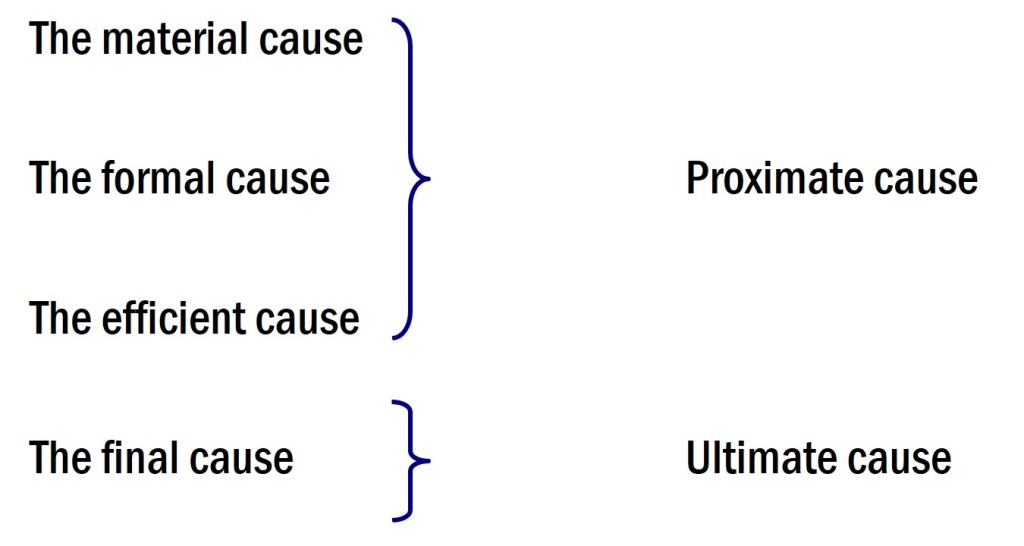
From a historical point of view, and in the Aristotelian system of thought, several sorts of cause were recognized. You should also notice that in modern science (especially in biology / evolution) using a teleological language is very common, but only amateurs believe in “ultimate cause”. Using teleological language makes the sentences much shorter, so out of laziness everyone may use it. For outsiders, this can be very confusing.
Determinism (1)
Determinism is the philosophical proposition that every event, including human cognition and behavior, decision and action, is causally determined by an unbroken chain of prior occurrences.
Determinism may also be defined as the thesis that there is at any instant exactly one physically possible future.
As is the case for many definitions that have been reproduced in this document, I don’t remember the source. But, whenever you encounter a term that you suspect it might have a special meaning in a field of knowledge, I strongly recommend that you look the meaning of that term in a few dictionaries and encyclopedias.
[Sidetrack – I have a feeling that when I was adding notes to this PowerPoint document in 2020, I must have become tired towards the second half of document, and my comments started to get shorter and shorter!]
Determinism (2)
The universe is nothing but a vast ocean of particles in motion … no more than a chain of events following one after another according to the law of cause and effect.
I have a distinct memory that the above sentence is somehow attributed to Pascal. The purpose of mentioning it here is to show that his sort of determinism is the result of a very mechanistic, reductionistic, and arrogant world view of 16th to 19th centuries. It is the kind of mentality that “scienticians” like Dr Frankenstein must have had.
Determinism (3)
Imagine an entity that knows all facts about the past and the present, and knows all natural laws that govern the universe.
Such an entity might, under certain circumstances, be able to use this knowledge to foresee the future, down to the smallest detail
This definition is also a reflection of the mechanical and deterministic worldview of 16th to 19th centuries. Nobody could really believe in this after 1905. My experience is that many scientists in humanity / social sciences think that natural scientists have this picture in mind. Of course, I think they have this misconception because the majority of them have no grasp of natural science of the past 120 years.
Newtonian determinism
The “billiard ball” hypothesis argues that once the initial conditions of the universe have been established the rest of the history of the universe follows inevitably. In this sense, the basic particles of the universe operate in the same fashion as the rolling balls on a billiard table, moving and striking each other in predictable ways to produce predictable results.
The above depiction must be one of the strongest statement of the mechanistic and deterministic world view of 16th to 19th centuries.
At this point it must have been clear that the old world view doesn’t seem to be right. There things about it that, we don’t like, I don’t like. So, if the above mentioned deterministic picture of the world is not the truth, then, what is the truth?
Lieutenant Daniel Kaffee: I want the truth!
Colonel Nathan R. Jessep: You can’t handle the truth!
You might recognize the above two sentences from the movie “A few good men”, with Tom Cruise and Jack Nicholson uttering those words in anger. Of course, in the movie Colonel Jessep is not telling the truth. [Sidetrack – There is something else in that movie that rings in my ears all the time: “Then why the two orders? Colonel?]
Is it conceivable that there is no truth? Or there are several truths? Or the truth is unattainable? Or the truth is so slippery that cannot hold on to it?
Nature of the things
Max Planck (1858-1947)
Albert Einstein (1879-1955)
Werner Heisenberg (1901-1976)
[Sidetrack – It seems that the method so effectively used by Jonathan Swift in his Gulliver’s Travels (1726) is also effective in natural sciences. My understanding of the method is that many common misconceptions are ingrained in us, that we cannot un-learn and re-learn many things, unless we change the context to extremes.]
The mechanistic and deterministic world view was so strong, especially after Newton, that the attempts to understand the extremes were needed to shake us off. Studying things as intangible as photons, or as small as electrons, or as big as galaxies were needed to change our understanding of the nature. It was between 1900 and 1927 that our understanding of the universe changed from the “old, mechanistic, and deterministic” to a “new, dynamic, and probabilistic”. This was facilitated by publications from three physicists. In December 1899 Max Planck published his paper on the duality of light as particle and wave. In 1905 and 1915/1916 Einstein presented his special and general relativity principle. Finally, in 1927 Heisenberg’s uncertainty principle came to our attention. Of course, there were many other details that were worked out in that period. Examples are the works of Niels Bohr and Erwin Schrödinger. However, in my judgment the impact of Planck, Einstein, and Heisenberg on other physicists and on philosophy was larger and, especially, better defined that the work of others.
Because the three concepts of duality of light, relativity, and uncertainty principles, have had an enormous impact on the development of science, and more importantly, on the development of philosophy of science, everyone should have, must have, an understanding of these. I would like to go to an extreme and claim that if you don’t have your own understanding of these concepts, you are not a part of contemporary intelligentsia (modern, educated, and cultivated person capable of critical thinking).
There are hundreds of popular-science books that discuss the four forces of “nature” (weak, strong, electromagnetic and gravity), and the theories explaining each of them, and possible future theories that may be able to combine these theories. One of the most famous books on this subject is the “brief history of time” by Stephen Hawking. This book has become old now. But he has another book together with one of 2020 Nobel winners Roger Penrose (The nature of space and time, 2010). Penrose has also a book from 2016. In any case, I recommend everyone to read one of these popular-science books about modern physics (including quantum mechanics) every 5 years.
[Sidetrack – There were scientists that had, implicitly, incorporated stochastic processes in their theories, most notably Darwin. However, it was not so much taken up by others until they were explicitly spelled out by physicists.]
Of course, you will be reading on your own about these concepts somewhere else. Before reading a good book, you may want to start from Wikipedia. Here, I will give a brief description of them.
Wave-particle duality of light
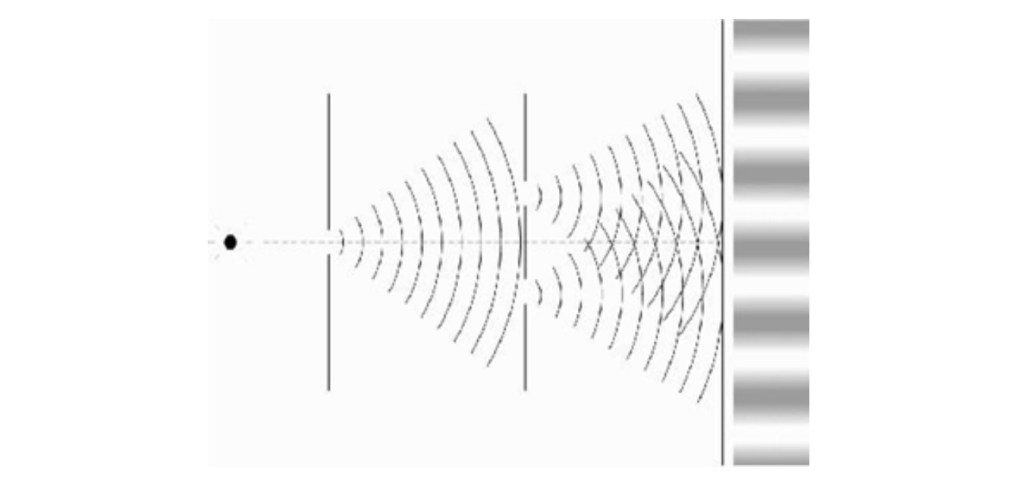
In this illustration the dot on the left side of the picture represents a source of energy (photon or electron), passing through a barrier that is opaque except for one slot, allowing only one particle at a time. The next opaque barrier has two slots. So if energy (photon or electron) was a particle, then it could not deviate from its path and go through any of the slots. However, experiments show that it passes through both slots. Not only that, but also a sensitive surface at the next barrier registers the full spectrum a wave function. In summary, photon and electrons behaves both as a particle and also as a wave. Later it was shown that even large particles have such a behavior.
The consequence is that at this fundamental level, we do not have one description of the nature, but two descriptions that are fundamentally contradictory. Further, none of them is capable of fully explaining the phenomenon.
Relativity
Special and general
Relativity is so famous and has entered the popular culture so much that everyone has heard about it. Try to learn about special relativity (more about simultaneity and nature of space/time) and general relativity (more about gravity and space/time curvature).
Special relativity started with some discussions about the speed of light, and how to measure it. It was postulated that given the position of the source of light and its motion, as well as the position of observer and its motion, the speed of light is “perceived” differently. As a vulgarization of the idea, I can argue that either the speed of light should go up and down for different observers, or the time must be dilated or compressed for different observers. In some ways the situation is more complicated than the wave-particle duality of light, because in special relativity we are confronted with the relative position and speed of infinitely many observers.
General relativity, as its name suggests is the generalization of special relativity to encompass passage of light in the vicinity of large objects such as suns (and even galaxies). The starting point maybe considered as how the light, or any electromagnetic wave-particle, traverses the universe, and the interactions that they should have with other such wave-particles. This leads to the supposition of the gravity bending light, i.e. light does not travel on a straight line. In full blown form, space and time make a continuum that is very “flexible”.
[Sidetrack – I have a memory of reading the following. However, I don’t remember where I have read it. Apparently, in a popular-science meeting (which might even had been televised) Einstein was asked to explain the general relativity theory. He looks towards audience and asks to burrow the checkered scarf of a lady. Then he asks four members of the audience the keep the scarf in a horizontally leveled manner. Everyone could see the lines on the scarf going in perpendicular angles to the sides. Then he picks up a fruit from the table (an apple or an orange) and places it on the center of the scarf. And everyone could see that the weight of the fruit created a curvature in the scarf, and the lines were not straight anymore.]
Uncertainty principle & Observer’s effect
Measurements of position and momentum taken in several identical copies of a system in a given state will each vary according to a probability distribution characteristic of the system’s state.
There are fewer “popular-science” versions of the uncertainty principle, because they are embedded in the description of quantum mechanics. The formal and initial description by Heisenberg is really about simultaneous measurement of the location and spin of an electron. Exactness of measurement in one, creates uncertainty in the measurement of the other. At this level, that’s the reason, the electrons around an atom should be shown like a cloud, because the path of each electron is uncertain. We can say that “within this cloud there is a probability that the electron might be at a specific place OR not”. Oh, let me correct myself: “within this cloud there is a probability that the electron might be at a specific place AND not”. Understanding this principle in terms of quantum mechanics involves understanding that “no two article in universe can occupy the same state”. This means that if you change something here, simultaneously something else, somewhere else will be changed.
One interesting vulgarization of the uncertainty principle is that if you want to examine an electron, for example by “throwing light” on it, the photon radiated on the electron changes the state of that electron. Hence, the act of observation changes the observed!! Let me repeat:
The act of observing a thing, changes the nature of that thing.
This is very important. Let’s open this up. I opening up this point, I will use the Jonathan Swift method mentioned above, i.e. I change the context to an extreme situation.
Example 1: Does YOUR knowledge of the distance between Moon and Earth affect the distance between the two? How about if you publish a scientific paper about it in a scientific journal? How about if you tell it to people in the prime-time TV news?
I guess your intuitive responses to these three questions are: “No”, “No”, and “No”!
Example 2: Does YOUR knowledge of the stock market and the ratio between share price and expected future income affect the stock market? How about if you publish a scientific paper about it in a scientific journal? How about if you tell it to people in the prime-time TV news?
How do you respond to these three questions? My guess is that your responses are: “No”, “Maybe”, and “Yes”!
Comparison of the above two examples should be quite revealing and educational. Using two extreme examples can, potentially, help us to realize that it is not easy to claim any definite knowledge about nature. Further, as our knowledge of the stock market affects the stock market, our knowledge (and examination of) electrons affects them. Rest assured that we our knowledge of the Moon will also affect the distance to the moon, but it is so imperceptible, that we conveniently ignore it. It is just like a fly stopping a train, but it is more extremely difficult to measure and perceive. [Sidetrack – You don’t believe me? I just Googled “Can a fly stop a train?”, and there was 227,000,000 hits.]
The general conclusion is that we cannot know the “true” state of nature. Nature can be a bunch of atoms (physics, chemistry), a solar system (astronomy), life on a planet (biology, ecology), the mental state of a person (psychology), how a small or large group of persons interact (sociology, anthropology), or how they manage their affairs (governance, democracy). Using a statistical jargon, the truth is not “fixed” so that you can pinpoint it. The truth is unknowable, unobservable and “random”, and there is, to burrow a Bayesian term, some uncertainty attached to it, i.e. it has a “probability distribution”.
Part III
Synthesis
The philosophical milieu
Karl. R. Popper (1902-1994)
Thomas Kuhn (1922-1996)
Now, in the void that we don’t know what method to use to acquire knowledge (induction or deduction), and we don’t know the nature of the phenomena (and we even don’t know what the truth is), we need to be pragmatist and decide how to proceed.
Planck’s theories are about very small things. Einstein’s theories are about very large things. [Sidetrack – with some simplifications and forgiveness, leave the middle sized things to Newton]. In the same way Popper is about small things (testing simple and singular hypotheses) and Kuhn is about large things (the collection of large number of hypotheses).
The original ideas proposed by these two in 1934 and 1962, respectively, have gone through many modifications by themselves and by others. For simplicity, let’s use the name “hypothetico-deductive method” for the “thing” that is attributed to Popper, and the name “paradigm shift theory” for the “thing” that is attributed to Kuhn. These two “things” are part of philosophy. However, their change, …, no, no, .., let me use another word, their evolution is not that different from scientific theories that they strive to explain.
To give evidence of the last statement is not easy, but nowhere can you find a better demonstration than the second edition of the “The Structure of Scientific Revolutions” by Kuhn, published in 1970. After publication of the first edition in 1962, Kuhn’s book had been subject to intense discussions and criticisms. [Sidetrack – Let me be a little bit naughty, and say “subject to intense conjecture and refutation”.] In the second edition Kuhn could have integrated the criticisms to refine his ideas and come up with a more coherent idea than the first edition. But he chooses to keep the book as it was in the first edition, and responds (reacts) to criticisms as post scripts. The modifications by Kuhn himself, and later modifications, and detailed specifications, by many philosophers, in the paradigm shift theory, is a good example of how a theory evolves.
Hypothetico-Deductive Method
An investigator makes use of the Hypothetico-Deductive Method (HDM) if he/she
1) Formulates and studies deductive systems of greater or smaller scope;
2) Embraces a particular system only as long as the consequences deduced from it are found to hold good under empirical testing;
3) As long as he/she does embrace a system, he/she does not ascribe certainty to it, but merely a probability which depends essentially on the number and kind of consequences that have been found to hold good under empirical testing.
A very short (and open) description of the hypothetico-deduction method is presented here. But everyone working in science (every sort of science, natural, social, etc.) should form their own opinion about this method. One must also be able to relate this to statistical testing. The reason for having “null hypothesis”, but trying to REJECT “alternative hypothesis”, the meaning of “confidence interval” or “probability interval”, and so on and so forth.
You’re out of order! You’re out of order! This whole trial is out of order! They’re out of order!
Popper has been accused of many things, including being a positivist. I will take up the subject of positivism in a different document. For here, it suffices to say that the majority of people accusing Popper have not read Popper themselves, and rely on (often second hand) judgment of the people who have misunderstood Popper. [Sidetrack – I will not be in the habit of giving references, but because I think Popper is unjustifiably attacked a lot, I give one reference here. For some examples of misunderstandings about Popper see: Hull, D.L. (1999) The use and Abuse of Sir Karl Popper. Biology and Philosophy. 14: 481-504].
Hypothetico-deductive method
The aim of science is not
TRUTH
but
PROBABILITY
I will discuss the differences between the “frequentist” and “Bayesian” schools of statistics in a different PowerPoint. Here I can briefly say that using Fisherian = Frequentist statistics you need to use induction. Based on the work of Hume, Popper recommendation is that because we cannot “prove” hypotheses, let’s concentrate on “rejecting” hypotheses. Further, “inductive” interpretation of statistical results is very difficult and you cannot make generalizations from them because of the “extrapolation” problem. Using Bayesian statistics, you need to use “deduction”. Then “conditional” on provisional=temporary hypotheses (as a temporary replacement for the “basic propositions”), you can work on rejecting your hypotheses and find a “probability distribution” that is useful for increasing your knowledge.
I cannot overemphasize that these were my ideas in 2007 or earlier. I have not had time to write a new coherent document to incorporate all the things that I have learned since 2007. I have written it in my “To do” list. I will do it. But I don’t know when.
 Hossein Jorjani